




Chain abstraction and dappOS: Intent-centered operation protocol
Sep 19, 2024 05:20:48


Author: 0xyin
In the latest article "Collaborate with Paradigm" released by top crypto venture capital firm Paradigm, ten potential trends in the Crypto space are highlighted, with the first being "intent-centric protocols and infrastructure."
Paradigm's view on "intent trading" suggests that the core focus in the realm of account abstraction is no longer on the precise "transaction" process, but rather on the ultimate "intent" of user transactions, which simplifies the cumbersome transaction steps inherent in crypto. Within this narrative, "intent" represents the desired outcome of the user, while "transaction" encompasses the exact steps needed to achieve that outcome. For instance, if a user wants to conduct an on-chain token transaction, the final transaction result reflects the user's ultimate "intent," but under that "intent," the corresponding "transaction" process involves a series of cumbersome, time-consuming, high-barrier operations, including potential cross-chain interactions and gas payments.
"Intent" allows users to define the outcomes they wish to achieve on-chain and outsource the work of achieving those outcomes to third-party "solvers," who interact directly with the network and protocols on behalf of the user. Ultimately, this layer of abstraction will make Web3 applications feel like regular applications, reducing the current technical learning curve and potentially helping the Web3 world attract millions of new users.


Description of limit order intents and continuous intent trading in "Powerful Intents: Part 1"
In the article series on intent by SevenX Ventures Research, three key factors that need to be met for an "intent"-driven world are outlined, which we strongly agree with.
● Outcomes over paths: Users only need to express their needs without worrying about how to achieve them.
● Conditional authorization over code authorization: When users sign blockchain transactions, they are authorizing the code within the transaction to perform arbitrary computations and modify blockchain states. In contrast, when users approve an intent, they authorize the release of their assets only after ensuring that their desired outcome has been achieved (similar to cash on delivery in online shopping).
● Competitive "solvers" as executors, rather than trusted dapps: In a transaction-driven world, users interact directly with dapps, which act as service providers to return the desired results. In an intent-driven world, on-chain and off-chain "solvers" compete to fulfill user intents and earn rewards. From an economic perspective, the more intense the competition, the higher the efficiency.
Based on the Web2 operating system concept, dappOS, positioned as a "Web3 operating protocol," is also an advocate of the "intent" narrative. It achieves abstraction from accounts to chains, automating complex high-barrier on-chain operations, allowing users to focus solely on the final intent of transactions without worrying about the implementation process. This project is an early example of the "intent" narrative direction.
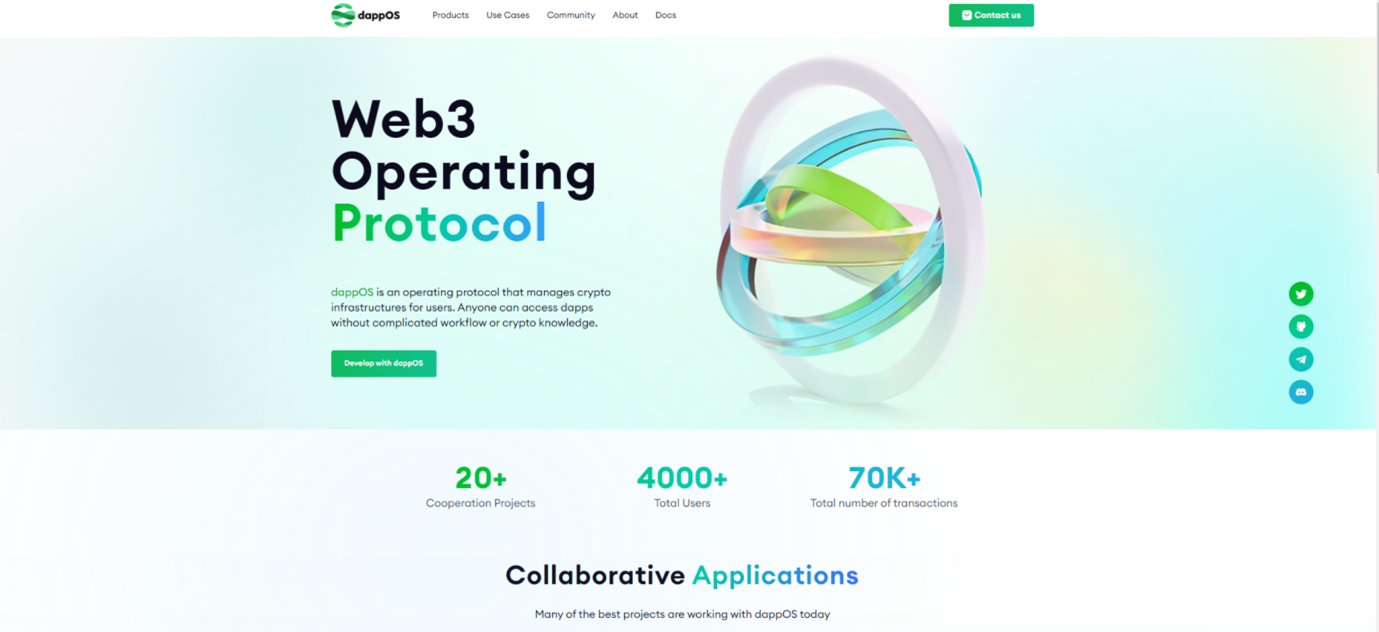
As the first intent-centric operating protocol, dappOS includes a unified account system based on account abstraction and the automated execution network dappOS Network. With its unified account system, dappOS enables users to access and trade with low barriers and friendliness while reducing the multi-chain customer acquisition costs for Dapp operators. The overall narrative direction of the dappOS project aligns with industry development trends, which may be one of the main reasons it has garnered significant industry attention.
At the end of last year, dappOS stood out from over 900 projects as an infrastructure project and was selected for the fifth season of the incubator program launched by Binance Labs. On June 23 of this year, dappOS received investment from Binance Labs, and on July 20, dappOS completed a seed round of financing led by Sequoia China and IDG Capital, with a valuation of $50 million.
dappOS Account: A Unified Account Built on Account Abstraction
dappOS Account is a unified account built on account abstraction that can provide traders with transaction services similar to CeFi while ensuring decentralization. Unlike traditional EOA accounts, account abstraction itself is a smart contract, and users do not manage their accounts solely through private keys or mnemonic phrases; they can specify recovery methods such as mobile phones or emails, similar to Web2 accounts. When users lose their mnemonic phrases or private keys, dappOS Account can be reset through various methods.
Based on dappOS Network, dappOS Account can achieve gas payment on behalf of users and provide the foundation for automating complex workflows. Therefore, users can integrate assets across multiple accounts and seamlessly trade assets across different chains using dappOS Account.
For example, when our assets are on the BNB Chain, but we want to use dApps on other chains like Avalanche or zkSync, dappOS Account can help users complete transactions seamlessly and without awareness. The complex operations involved in the transaction are handled by service nodes within the dappOS Network (users only need to pay the total fee once). When the balance in the account address is insufficient, the system can automatically pull equivalent assets from other chains after user confirmation for combined payment. With dappOS Account, the entire transaction process can be shortened from over ten minutes to under two minutes.
The dappOS protocol meets the basic elements of the "intent" world described by SevenX Ventures Research. Through dappOS, users only need to input their needs via a unified account to seamlessly and effortlessly execute multi-chain transactions with one click, complete complex transaction operations involving any number of chains in a specific order, etc. (not a single intent, but capable of executing a set of intent graphs). In this process, users do not interact directly with dapps but drive "solvers (dappOS service nodes)" to execute specific tasks by approving intents and authorize the release of assets only after the transaction is successfully completed.
dappOS Network serves as the executor or "solver" of the entire intent trading process, rather than a single trusted dapp. Through a new service network characterized by competition and incentives, the intent world of dappOS will achieve a virtuous cycle and self-sustainability. In future technical version iterations, dappOS is expected to meet a richer set of intent graphs.

Description of intent icons in "Powerful Intents: Part 1"
The "intent" narrative draws inspiration from the development of Web2. Clearly, to meet the "intent" narrative, Web3 infrastructure needs to provide an easy-to-use and powerful user experience, and dappOS serves as an excellent early demonstration of the intent narrative.
The New V2 Version
Currently, dappOS has completed MVP product validation and testing and is about to launch its first official version V2, with the first batch of integrated projects set to go live soon.

This version's main new features and characteristics include the unified account mentioned above, task-related order execution, and a new node bidding system. Meanwhile, from November last year to now, dappOS has successively completed security audits by well-known auditing firms Secure 3, CertiK, and Trail of Bits, providing a foundation for the stable release of the V2 version with high security standards.
● Task-related order execution
Task-related order execution is a new feature of dappOS v2. When users conduct transactions, they can confirm the completion of complex transaction operations involving any number of chains with a single signature.
● New node bidding system
dappOS V2 also introduces a new node bidding system, allowing users to choose service nodes autonomously during transactions, while service nodes can also start to profit through this system. Based on this bidding system, when users trade using dappOS, they can filter service nodes from the node bidding list to further enhance transaction efficiency and reduce transaction costs.
With this bidding system, service nodes receive revenue incentives. Service nodes that are efficient and cost-effective have a higher probability of successfully "taking orders" to fulfill user transaction needs, thereby promoting healthy competition among service nodes in the network and driving self-renewal and optimization of the dappOS Network transaction system. The latest disclosed dappOS V2 roadmap indicates that the V2 Stage 2 phase will also launch a platform for service nodes to connect autonomously, providing various specifications for open-source implementations.

dappOS is About to Release V2 Beta Version
● Manage multi-chain assets through a unified account
The dappOS v2 version will launch a new unified account system, where the dappOS Wallet interface can display the total amount of all multi-chain assets in the user's unified account.

In the detailed asset balance display below, the total amount of that asset in the multi-chain account is shown. For example, the displayed USDC asset quantity is approximately 7.95, which actually represents the total amount of USDC across the Avalanche, BNB Chain, and Polygon chains. By expanding this, we can see the actual quantities corresponding to the multi-chain account.

In fact, when we use the dappOS Wallet for on-chain transactions, we only need to focus on the displayed total amount across chains. When transacting or making payments, we can achieve one-click payment based on the unified account without the need for cumbersome multi-chain operations.
● Purchase GLP on GMX through dappOS
Currently, GMX is one of the first partners of dappOS, and we can conveniently purchase GLP on GMX through the task-related order execution feature of dappOS.
We have also linked GMX, which integrates the dappOS system version, through the dappOS Wallet.

After confirming the purchase exchange rate and clicking the "Buy GLP" button, users can see detailed transaction fees, including the total gas fees and bridge fees involved in the one-click multi-chain payment.

We can further check the details of gas fees and bridging costs. We see that the assets used to pay the aforementioned fees can be the trading asset USDC, and when the USDC balance is insufficient, it automatically offsets with other assets (the offset asset can be selected; we chose USDT on the Avalanche chain to pay the fees).


Upon final confirmation, one-click payment can complete the purchase of GLP, and the entire transaction process can generally be confirmed within one minute.

Currently, in addition to GMX, several other mainstream DeFi protocols, such as Benqi, Perpetual, and Pangolin, which have launched MVP versions through dappOS, will also integrate dappOS V2.
Conclusion
The "intent trading" narrative proposed by Paradigm is an excellent idea with immense potential, likely to help the Web3 world achieve a new transformation. dappOS aligns with the "intent" narrative proposed by Paradigm, automating cumbersome transaction steps in a decentralized manner based on user "intent," making "intent" the dominant element throughout the transaction process. From the application side, dappOS breaks down multi-chain barriers in a "Web3 operating protocol" manner, significantly reducing customer acquisition costs for Web3 applications across different ecosystems and providing more convenient operations and momentum for the long-term development of Web3.

Related Projects

Latest News
Dec 08, 2025 11:25:39
Dec 08, 2025 11:19:21
Dec 08, 2025 11:12:54