








ArkStream Capital: The future of application chains is promising, and the opportunities for applications have arrived
Sep 11, 2024 17:00:52


TL;DR
The development of application chains is the result of multiple factors, including the maturity of infrastructure, increased competition for block space, and a growing demand for customized token economic models.
While dApps and application chains share similarities in business forms, each has its own advantages and limitations. If the emphasis is on synergy with the ecosystem, dApps may be more suitable, whereas if autonomy and independence are pursued, application chains are the better choice.
The development of Cosmos and Polkadot is constrained by both technical challenges and the high barriers to entry for application chains due to economic mechanism design.
The core of application chain development lies in building its own application moat, fully utilizing low-cost transactions to promote high-frequency on-chain trading, thereby gaining traffic and accumulating users. While technical support and enhancement are important, they are auxiliary factors rather than core elements.
Future application chains can address existing liquidity fragmentation and interoperability issues through technologies such as aggregation layers, superchains, or chain abstraction.
Although the market capitalization or fully diluted valuation of application chains may receive some enhancement, the key factor remains the product quality and user experience of the applications themselves.
Inevitability of Application Chain Development Trends
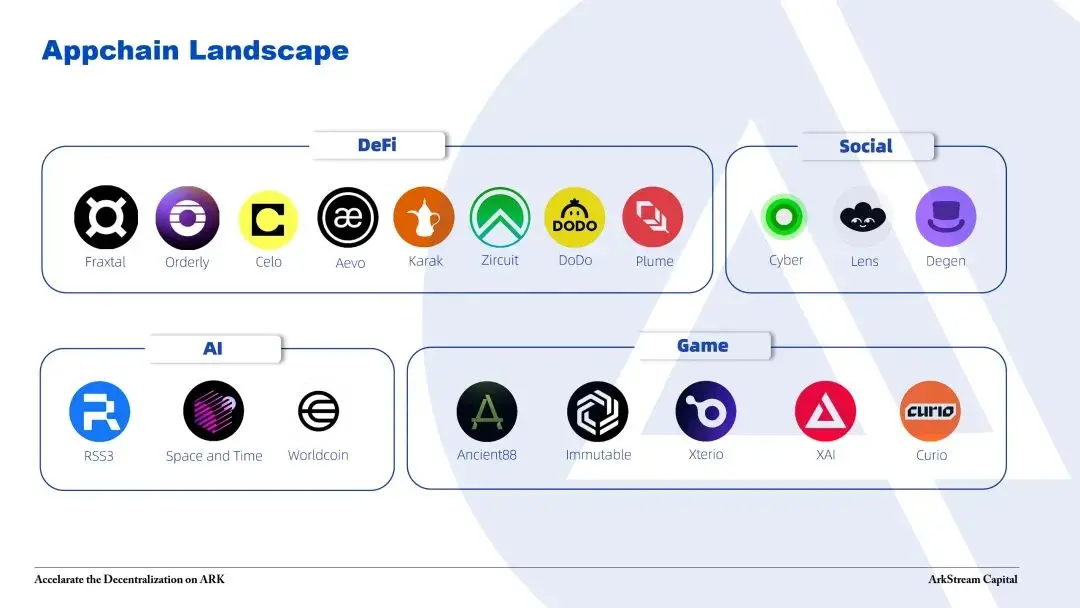
In 2023 and 2024, an increasing number of dApps announced their transformation into application chains. In response to this phenomenon, we surveyed the entire application chain track and found that these application chains are mainly concentrated in areas such as DeFi, gaming, social, and AI. We believe that the development of application chains has become an inevitable trend due to the maturity of modular technology, the widespread validation of general Rollup Layer 2 networks, the increase in RaaS platforms, and the optimization of services, as well as the competition for public chain block space resources, the optimization of end-user transaction costs, and the demand for customized token economics driven by dApps.
Regarding this trend, we believe that the upgrade of dApps to application chains will not immediately transform into a highly valued infrastructure layer, as dApps and application chains are more of a technical choice rather than a decisive factor for success. The advantage of application chains lies in promoting more high-frequency on-chain transactions through low-cost trading, utilizing data accumulation to enhance user product experience, forming user stickiness, and thus achieving network effects. Therefore, the core of application chain development still lies in its unique application moat and traffic.
Exploring the Origins of Application Chains
When discussing the origins of application chains, we must mention the pioneering project Cosmos. Cosmos is known for its modular and pluggable design philosophy, separating the virtual machine and consensus engine, allowing developers to freely choose the framework for building virtual machines and customize key parameters of the consensus engine, such as the number of validators and TPS. This design enables various applications to exist as independent chains, showcasing unique advantages in flexibility and sovereignty. These innovative ideas have made significant contributions to the exploration and practice of application chains, laying a solid foundation for this field.
Looking through Mintscan's development of the Cosmos application chain ecosystem, we find that many well-known and mature application chains are built on the Cosmos framework, such as dYdX, Osmosis, Fetch AI, Band, and Stride. However, the overall growth trend of Cosmos application chains has not been sustained, and the number of new application chains has not significantly increased. We believe this is mainly due to the excessive sovereignty granted to application chains by Cosmos, and before the launch of the Atom 2.0 ICS proposal, the high security and startup/maintenance costs of application chains were the primary reasons.

Typically, building a Cosmos application chain requires the project team to be equipped with developers familiar with the Cosmos SDK and Tendermint consensus engine, which poses an additional technical burden for technology teams primarily focused on application development. Furthermore, even if a Cosmos application chain can be staffed with sufficient technical personnel, the startup logic of most application chains is to attract early validators to participate and ensure network security by airdropping tokens to Cosmos validators, while incentivizing validators to maintain network security through high inflation rates. However, this practice has the side effect of accelerating token depreciation, leading to a rapid decline in network value. This situation makes it increasingly difficult for application chains to establish a foothold in the market.
Under the ICS proposal advocated by Atom 2.0, the concept of application chains will be upgraded to the Permissionless Consumer Chains model, which, although it allows permissionless entry into consumer chains and reduces the cost of acquiring security for consumer chains, may face inefficiency issues similar to the slot auction mechanism of Polkadot due to its DAO-based voting governance form.
Additionally, we find that Cosmos lacks attractiveness for application chains in aspects such as chain liveness characteristics, developer documentation resources, and community culture. For instance, the block halting event that occurred in Cosmos Hub this year, the lack of comprehensive developer documentation resources during the booming period of inscriptions at the end of 2023, and the small circle issue pointed out by Delphi co-founder José Maria Macedo have all negatively impacted the entry of new application chains.
Catalysts for New Application Chains
If we view the early application chains of Cosmos as chain-oriented applications emphasizing sovereign design, then new application chains are more application-oriented, focusing on their own application development. The rise of these new application chains is mainly attributed to the popularization of modular blockchain concepts, the maturity and widespread validation of general Rollup Layer 2, the development of interoperability and liquidity aggregation layers, and the rise and improvement of RaaS platforms.
As one of the first Rollup Layer 2 to launch its mainnet, Optimism's successful launch in 2022 marked the practical implementation of modular blockchain theory. Optimism not only inherits the security of Ethereum but also fully supports the development tech stack of the Ethereum ecosystem. Optimism demonstrated to the industry how Rollup can efficiently scale Ethereum while also promoting in-depth exploration of Layer 2 solutions within the industry. Building on its own development, Optimism innovatively proposed the OP Stack concept, which has been widely adopted in well-known projects such as Worldcoin and Base, further attracting significant attention in the industry. Subsequently, other Rollup solutions also launched similar concepts, such as Arbitrum Orbits, Polygon CDK, StarkWare Appchain, and zkSync Hyperchains. As a result, for dApps, application chains have become a new avenue for implementing business logic, making the upgrade of existing dApps no longer a challenge, with the main challenges shifting to technical selection, business design, and operational maintenance.
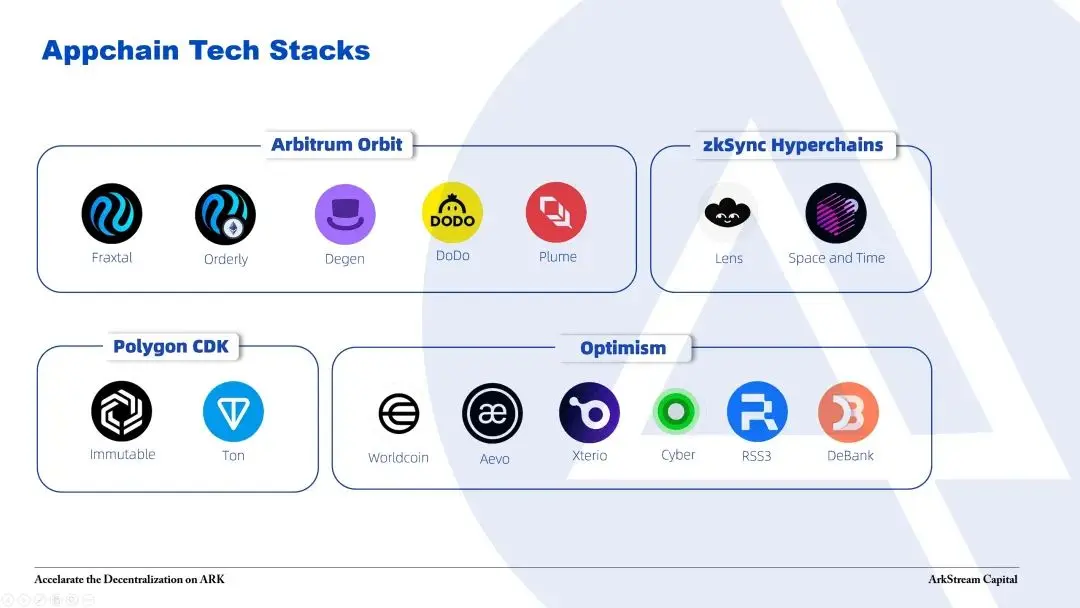
When implementing Rollup solutions, it is usually necessary to choose a suitable execution layer framework, such as OP Stack or Arbitrum Orbits. Taking OP Stack as an example, it is an evolving Rollup framework that must be upgraded alongside Ethereum's updates (such as the Blob feature in Cancun) and will also support emerging functionalities (such as Alternative Data Availability). To simplify the understanding, we outline the application chain development process roughly following these steps:
Technical selection: Evaluate the functions and characteristics of different frameworks and choose the most suitable one.
Requirement design: Design an application chain that meets the needs based on the customization capabilities of the corresponding framework.
Operation and maintenance: Complete deployment, testing, launch, and subsequent maintenance.
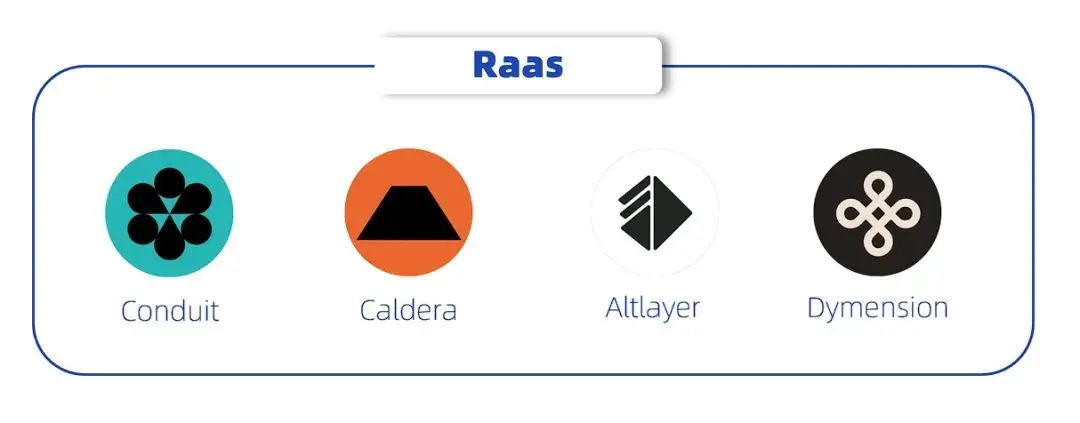
Although Rollup frameworks provide powerful scalability for applications, selecting and implementing the appropriate framework is not easy, especially since making changes after the application chain is launched becomes more complex. Therefore, the emergence of RaaS (Rollup As A Service) platforms like Altlayer, Caldera, and Conduit is particularly important. These platforms are similar to SaaS but focus on Rollup solutions, helping dApps quickly select different Rollup frameworks, simplifying the complex steps in the application chain development process, providing customized core features, and supporting maintenance and optimization after the application goes live.
At the same time, the infrastructure and related functionalities surrounding application chains are also rapidly advancing, with the industry continuously introducing highly attractive protocols and features. For example, projects like Celestia, EigenDA, and NearDA have introduced Alternative Data Availability to reduce costs and improve throughput, while RaaS platforms have successively launched integrated support for features like custom Gas tokens and native account abstraction. With the widespread application of Rollup application chains, liquidity fragmentation and interoperability issues have gradually emerged, prompting solutions for aggregation and unification layers, such as Optimism's Superchain, Polygon's AggLayer, Caldera's Metalayer, and zkSync's Elastic Chain, which aim to improve interoperability and liquidity aggregation among application chains.
If the aforementioned catalysts have lowered the barriers to entry for application chains, the current application dilemmas in the primary and secondary markets are intensifying dApps' exploration for breakthroughs. Data from CMC and Rootdata shows that among the top 100 projects in the secondary market, excluding community-driven and culturally supported Meme types, only a few pure application projects like Uniswap, LDO, Aave, Ondo, Jupiter, and Ethena exist, while most others belong to infrastructure. This implicitly confirms that infrastructure holds a higher status than applications in the entire Crypto industry. Correspondingly, in the primary market, the financing amounts for application types are also far lower than those for infrastructure types. We believe that part of this phenomenon is due to the relatively complex UI/UX of Web3 applications, which is far less mature and user-friendly than Web2, while the related innovations in application paradigms have not truly broken through. Nevertheless, we believe that the potential of application chains has not been fully released and may become an important breakthrough for driving the development of Web3 in the future. Currently, there are several well-known application chain projects, such as IMX, Cyberconnect, Project Galaxy, and Worldcoin, which are showcasing the immense potential of application chains.
Advantages and Disadvantages of New Application Chains
In the fields of technology and innovation, "silver bullets" are often used to describe perfect solutions that can solve all problems. However, in reality, there is hardly any technology that can solve all problems at once. Similarly, new application chains are not a panacea and do have their flaws. Below, we analyze their advantages and disadvantages:
Advantages
- Modular Design: Application chains typically adopt a modular design, allowing developers to customize infrastructure components such as settlement mechanisms and data availability to meet specific needs.
- Performance Optimization: Many new application chains can achieve cost reductions and improved throughput by introducing other data availability layer solutions.
- Enhanced Value Capture: Features like custom Gas tokens and account abstraction can support more flexible application development and enable more complex business models and token models.
Disadvantages
- Liquidity Fragmentation: New application chains may face liquidity fragmentation issues.
- Interoperability and Composability Issues: Application chains cannot easily combine and interoperate like past dApps on public chains.
- Increased Complexity: Compared to traditional dApps, new application chains have increased complexity, especially in design and implementation, which may require more technical resources and support.
Core Considerations for Deciding on Application Chains
From the perspective of project parties, when deciding whether to upgrade or choose an application chain, it is advisable to follow these principles:
- 1. Dependence on Existing Public Chain Features: If your application heavily relies on other dApps on the public chain, such as liquidity or product functionality, it is recommended to continue using existing dApp solutions.
- 2. Need for Custom Features: If the current application struggles to support business needs such as account abstraction or specific onboarding mechanisms (revenue sharing) at the protocol level, and these features are crucial for business development, then it is advisable to choose or migrate to an application chain.
- 3. Cost Sensitivity: If end users are sensitive to block space resources or wish to reduce losses like MEV, application chains may be a better choice. Additionally, if the application belongs to high-frequency interaction scenarios, application chains can provide higher resource efficiency and lower transaction costs.
Building Moats and Development Routes for Application Chains
We believe that the moat of application chains is always their own application business. The key to success lies in deeply exploring market pain points and building products that achieve PMF (Product Market Fit). Simply relying on the narrative of application chain infrastructure is a rigid mindset akin to "finding nails with a hammer" and is not an effective way to build a moat.
In the current wave of new application chains, how to build publicly transparent, low-cost on-chain applications, grasp market demands, solve product pain points, refine complete and secure products, and establish a large and rich accumulation and analysis of user data, combined with a cash flow model business model, to form strong user stickiness and scale effects is key.
A high-profile approach may not necessarily suit application chains. At least until the core product is perfected and user data and growth metrics are fully established, application chains should focus on development primarily, with promotion as a secondary concern. The accumulation of user data, cultivation of user habits, and iterative updates of product features are not achieved overnight, so a steady and solid development approach is more suitable. Applications should first quickly form their core functions, even irreplaceable functions. Based on this, new features and product lines can be developed, so that even when encountering lukewarm responses to new features and product lines, a defensive abandonment strategy can be adopted. Correspondingly, in the upgrade iterations of application chains, deeper integrations with existing application functions can also be pursued multiple times.
Taking the well-known portfolio visualization asset management platform Debank as an example, it established tracking and observation of assets, transaction flows, dApps, and other positions related to ETH and EVM-compatible wallet addresses long ago, and iterated numerous features based on this. Although Debank has many relatively lesser-known features, such as notifications, bookmarks, and greetings, this does not affect our appreciation for its core asset management functionality. For Debank's paid features, we can see their dedication in this regard; the diverse and granular paid features and the integrated optimized package functionality provide users with thoughtful choices. The overall data performance of these features is good, and they synergize well with Debank's other product line, Rabby Wallet. Even though Debank promotes the development of Debank Chain based on OP Stack, users do not have a noticeable perception of it. This indicates that Debank's application chain effectively demonstrates how to build a core moat for applications and provides valuable references for the development route choices of other application chains.


Token Design Thinking
When constructing the token economic model for application chains, we advocate for a strategy of organic development. The core of this strategy is to reduce human intervention and avoid reliance on short-term incentive measures. Our hope is to align the circulation and value growth of tokens with the expansion of the application itself and the increase in the user base. In this way, the token economy can synchronize with the long-term development of the application and the actual needs of users, achieving sustainable growth.
Tokens can serve as a powerful tool to attract users in the early stages of the application, achieving what is known as a "cold start." However, to ensure that these initial users are not only attracted but can also be converted into long-term users, it is crucial to design an efficient and appealing mechanism. This mechanism needs to be based on a clear positioning of the application product, deep insights into user needs and preferences, and a comprehensive understanding of the business scenario. Additionally, the core value of the token must be established to ensure that users recognize its long-term potential and benefits. Through such a strategy, tokens can not only attract users but also promote their continued engagement and in-depth use of the product.
The growth in the number of token holders should align with the expansion of the user base to ensure the healthy development of the token economy. We should avoid overly aggressive token distribution strategies and instead strive for a model of sustained growth. This requires us to fully consider current market liquidity and potential market changes, as well as ensure that the token economic model is closely linked to the vision of the application. Furthermore, NFTs, as a new type of reservoir asset, can provide users with diverse usage scenarios through innovative and appropriate combinations, which also helps enhance the attractiveness and market competitiveness of tokens.
Learning from failed cases is key to avoiding mistakes when designing tokens for application chains. Taking Aevo as an example, as a new coin that recently landed on Binance, it is not affected by liquidity shortages. By attracting a large number of early users through token airdrops, Aevo has established a foothold in the pre-market trading sector. Unfortunately, Aevo's overly aggressive and unrestrained token design model ultimately harmed the core data growth of the product. Currently, Aevo shows stagnation in key indicators such as the growth of token holders, daily trading activity, and the basic market conditions of pre-market trading. Therefore, to build a token economic model that attracts users while being sustainable in the long term, we advocate for an organic development approach, focusing on driving the natural growth of tokens and the expansion of applications through intrinsic value and user needs.

Overview of Notable Application Chain Projects
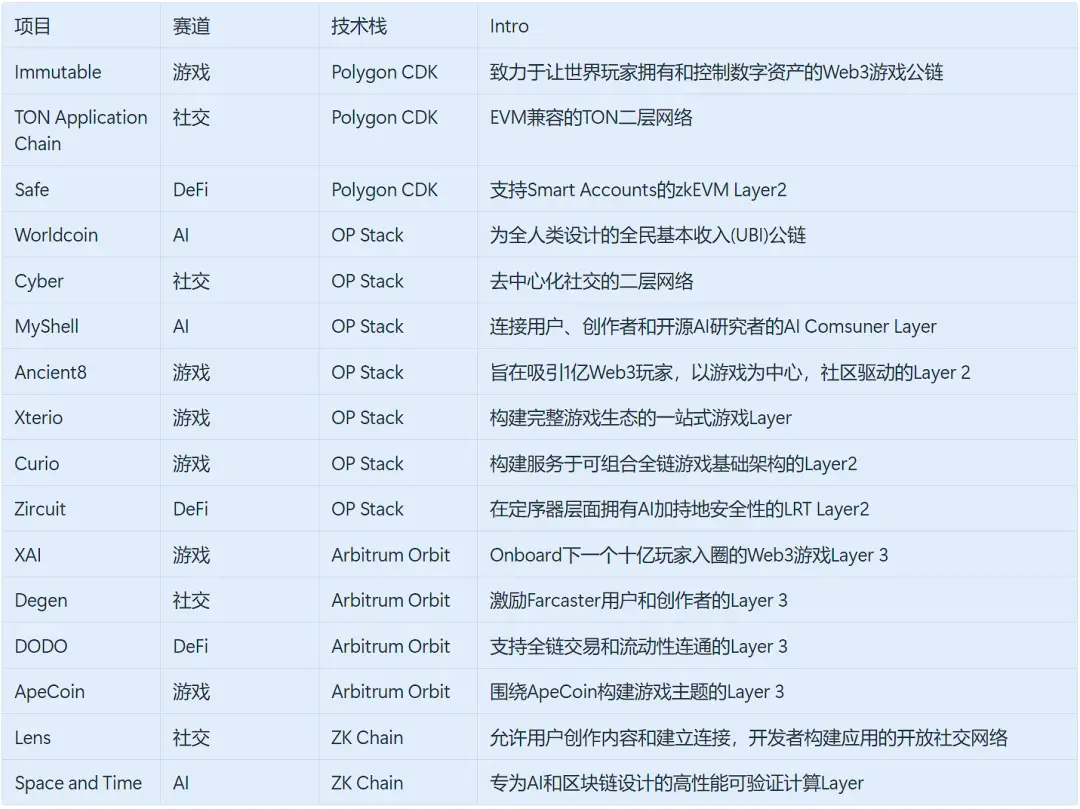
Let’s take a closer look at some of the currently prominent application chain projects in the market and analyze them.
Cyber
Cyber is a Restaked Ethereum Layer 2 network focused on social scenarios, optimized for mass adoption. Core features include native account abstraction, CyberGraph and CyberAccount supporting the Enshrined Social Graph Protocol, low-cost efficient decentralized storage CyberDB, and decentralized sequencers. The core application product is Link3, which allows verified Web3 companies and professionals to create reusable data on-chain, which can be combined with other applications.
XAI
XAI is a game-oriented three-layer network developed by Offchain Labs that is EVM-compatible, utilizing Arbitrum technology. XAI allows players to own and trade their in-game items without using cryptocurrency wallets, while node operators in the XAI network participate in network governance and receive corresponding rewards, thereby building a gaming ecosystem with an open and authentic economic experience for traditional gamers.
MyShell
MyShell AI is an innovative AI agent creator platform that connects users, creators, and open-source AI researchers in a Consumer AI Layer. Users can quickly customize agents with personalized voice styles and functionalities using MyShell's exclusive integrated text-to-speech technology and AutoPrompt tools. For agent creators, they can efficiently create and publish AI agents and integrate monetization channels to earn revenue from their agents.
GM Network
GM Network aims to be an innovator in the consumer AIoT space, utilizing advanced AltLayer technology combined with EigenDA and OP Stack to create a decentralized DePIN, aimed at customizing personalized AI agents for users. GM Network's goal is to build a large incentive and communication platform that promotes the widespread application of AI technology on the consumer side by merging DePIN/IoT technology with AI, thus bridging the virtual and real worlds.
Other Projects
Investment Analysis Framework
When conducting investment analysis, we adopt the following framework to ensure a comprehensive and in-depth evaluation of applications:
Industry Understanding and Market Positioning: Deeply understand the gameplay and operational models in the crypto space, knowing how to identify market pain points and propose innovative application solutions.
Target Customer Base: Applications target a large and potential user base, as this directly impacts their market cap ceiling.
Product Delivery and Iteration Speed: Compared to infrastructure, applications need strong product delivery capabilities and rapid iteration speeds to ensure continuous optimization and innovation of product features.
User Retention and Business Model: Applications must build strong user retention capabilities and achieve sustainable growth through GMV growth and matching business models.
Through this framework, we can systematically assess the comprehensive strength and market prospects of projects, providing a solid basis for investment decisions.
Outlook
We hold an optimistic view on the development prospects of application chains. This optimism is based on the role of application chains as core platforms for user activities, which can play a crucial role in diverse fields such as social interaction and gaming. In the future, these application chains will not only provide users with rich interactive experiences but also drive innovation and development in related industries through their unique technological advantages!
Aside
The application business forms for both B2B and B2C have their characteristics, but their approaches to integrating with application chains are similar. This article will not strictly differentiate between the two but will focus on how they utilize application chain technology to achieve business goals and growth.
The main difference between Layer 3 and Layer 2 application chains is that Layer 3 uses specific Layer 2 as the settlement layer and data availability layer, meaning structurally there isn't much difference from Layer 2.
The Solana official stance does not explicitly support the development of Layer 2, as its focus remains on building around the high-performance Solana public chain. The ideas for some Layer 2 or application chains on Solana are similar to those of Ethereum-based application chains, differing mainly in execution frameworks and data availability layers.
The current state of Layer 2 may seem like a ghost town, but the actual reason is that some Layer 2 are overly reliant on the on-chain prosperity created by token airdrop expectations, without sufficient operation and maintenance of the ecosystem. According to Defillama's https://defillama.com/chains, data for Layer 2 like Arbitrum and Base is also very active.
The revenue-sharing models between application chains and RaaS generally have various patterns, such as fixed fees or distribution based on sequencer income, allowing different-sized application chains to choose based on their business situations.
References
Cosmos Hub
https://x.com/cosmoshub/status/1798512843853271223
Cosmos Hub Forum CHIPs Discussion phase: Permissionless ICS
https://forum.cosmos.network/t/chips-discussion-phase-permissionless-ics/13955
PANews Delphi Digital: After analyzing all L1 blockchains, why did we ultimately decide to develop on Cosmos?
https://www.panewslab.com/zh/articledetails/s5m1eokl.html
Geek Web3 (GeekWeb3) on Twitter / X
https://x.com/geeksweb3/status/1737533996601680047
Cosmos Hub experienced nearly 4 hours of downtime early in the morning, and block production has now resumed
https://www.mitrade.com/cn/insights/news/live-news/article-3-199606-20240606
Juno Network attacked, mainnet halts block production! JUNO price drops over 5%_Btcfans
https://www.btcfans.com/en-us/article/78341
Application-Specific Blockchains | Explore the SDK
https://docs.cosmos.network/v0.50/learn/intro/why-app-specific
Mintscan
https://www.mintscan.io/visualization/validators/binancenode
José Maria Macedo
https://x.com/ZeMariaMacedo/status/1711365326976262545?t=NuGHO0wY5J-QgRjfnDgb7A&s=05
RPC & Node Providers | Optimism Docs
https://docs.optimism.io/builders/tools/connect/rpc-providers
Dune Analytics Optimism Overview
https://dune.com/Marcov/Optimism-Ethereum
StarkWare What are Appchains?
https://starkware.co/blog/what-are-appchains/
Superchain Ecosystem | Chains
https://www.superchain.eco/chains
Orbit Ecosystem
https://portal.arbitrum.io/orbit/ecosystem
Build ZK powered blockchains
https://polygon.technology/polygon-cdk#
L2BEAT - The state of the layer two ecosystem
https://l2beat.com/scaling/summary
Dune Analytics DeBank Layer2 Dashboard
https://dune.com/stakeridoo/debank
SimilarWeb
https://www.similarweb.com/website/debank.com/#traffic
DeBank | The Real User Based Web3 Community
https://debank.com/paid
TokenTerminal
https://tokenterminal.com/terminal/projects/aevo?v=ZmE2MjZm
Haotian | Crypto Insight on Twitter
https://twitter.com/tmel0211/status/1790988512545902797
Delphi | What is Appchain?
https://members.delphidigital.io/learn/application-specific-blockchain
The Benefits and Tradeoffs of Application-Specific Blockchains
https://www.infura.io/blog/post/the-benefits-and-tradeoffs-of-application-specific-blockchains
Related Projects



Latest News
ChainCatcher
1월 17, 2026 23:06:54
ChainCatcher
1월 17, 2026 22:51:26
ChainCatcher
1월 17, 2026 22:30:28
ChainCatcher
1월 17, 2026 22:17:57
ChainCatcher
1월 17, 2026 22:05:06