








The Night Before the Storm: Powell Does Not Cut Interest Rates, Trump Announces New Federal Reserve Chairman?
Jan 28, 2026 20:24:16


Author: Golem, Odaily Planet Daily
At 3 AM Beijing time on January 29 (this Thursday), the Federal Reserve is set to announce its first interest rate decision for 2026; half an hour later, current Fed Chair Powell will hold a monetary policy press conference. However, there is not much suspense surrounding this Fed interest rate decision, as the market widely believes that the Fed will decide to keep rates unchanged. Data from Polymarket shows that the probability of maintaining the current interest rate is close to 100%.
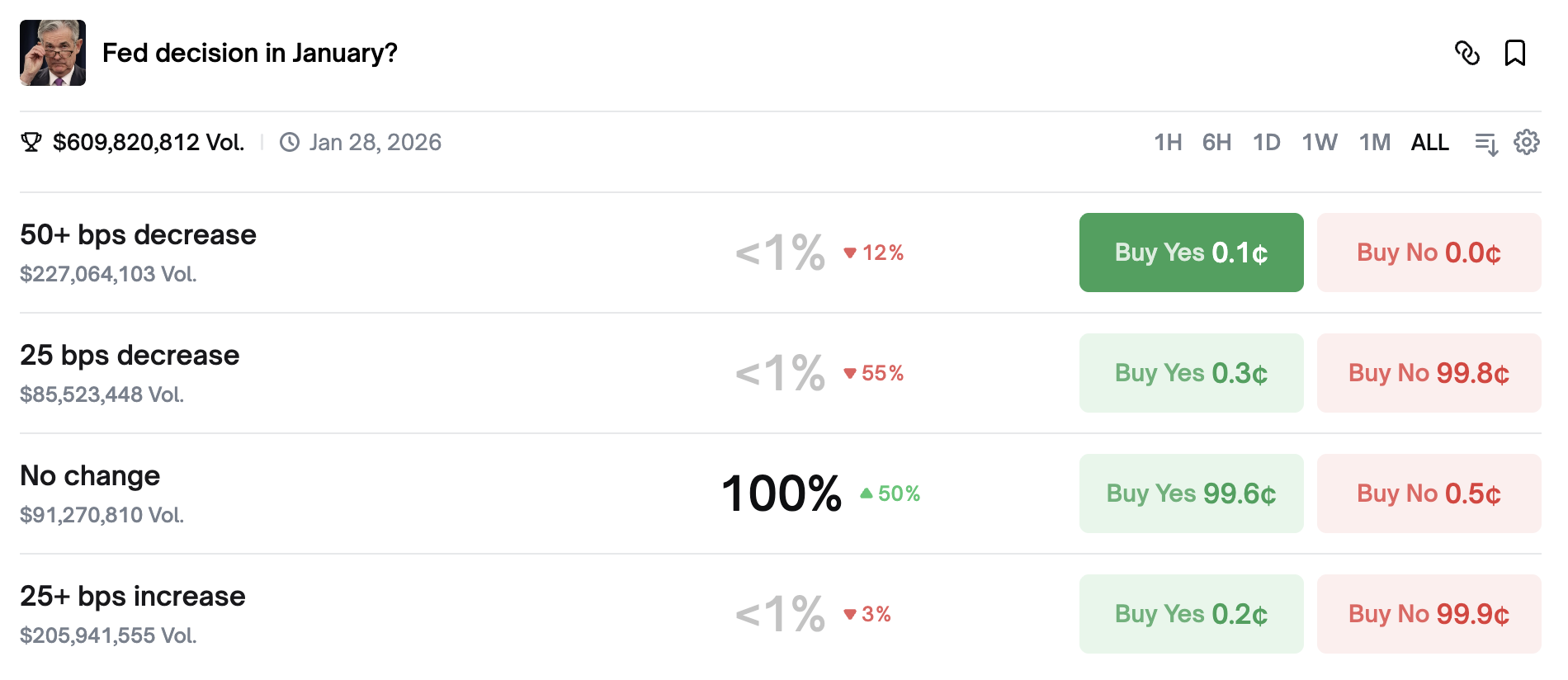
Such a high probability allows the market to digest the negative impact of the Fed's announcement of "no rate cut" in advance. Data from OKX shows that BTC has only fallen by 0.39% in the past 7 days, remaining largely stable, but this "quiet period" may be broken tonight.
On one hand, while the market almost unanimously believes that the Fed will keep rates unchanged this week, there is significant divergence regarding the fiscal path for the remainder of 2026, making this an important wait-and-see meeting. The Fed's future key policy tendencies, such as whether it will continue to cut rates in 2026 and the frequency of rate cuts, will affect the market. If Powell makes hawkish statements like "we need to continue observing" during his speech, the market may "respond with a drop."
On the other hand, the announcement of the successor to the Fed Chair will also have a long-term impact on the market. The candidate pool has now narrowed to four individuals, Trump has previously indicated he has a preferred candidate but will wait for the right time to announce, and that right time may very well be tonight.
The Direction of Rate Cuts in 2026 Remains Uncertain
Since September of last year, the Fed has initiated a new round of rate cuts, having cut rates three times in a row. If it maintains rates this week, it will be the first pause since the start of the rate-cutting cycle. At this point, the market is not concerned about the reasons for keeping rates unchanged, but rather whether this is a brief pause in the rate-cutting pace or the beginning of a long-term pause in rate cuts, or even the start of a rate hike cycle?
Previously, the prevailing view in the market was that 2026 would be a year of further quantitative easing by the Fed.
One reason is that, from a data perspective, the U.S. labor market is indeed showing signs of weakness, with non-farm employment increasing by only 50,000 in December 2025 and an unemployment rate of 4.4%. Although there are no "mass layoffs," the market is still in a state of "low hiring and cooling demand." Another reason is that the Fed may still believe that Trump's tariff policies will not have a long-term impact on inflation * (Odaily: In September 2025, Powell cut rates based on this factor) *; a third reason is that Trump has previously publicly stated that he would choose a "dovish" figure to be the next Fed Chair.
However, there are also views in the market that the Fed's continued rate cuts in 2026 remain uncertain. Some analysts believe that unless the job market deteriorates significantly, it will be difficult to see rate cuts before mid-year, as the pace of inflation decline is not sufficient to persuade hawkish committee members.
The Fed's task, simply put, is to curb inflation and promote employment. However, in 2025, the U.S. experienced a phenomenon of both a weak labor market and high inflation. The Fed ultimately chose to prioritize solving employment issues, which is why it initiated the rate-cutting cycle. However, the reality is that the U.S. inflation rate remains stuck at 2.8%, far above the Fed's target of 2%, which forces the Fed to reconsider the impact of tariffs on inflation. If it maintains rates this week, it also indicates that the Fed is beginning to "wait and see."
On the other hand, although Trump's choice for the next Fed Chair is bound to be "dovish," the new rotating chair of the Fed's rate-setting committee is predominantly "hawkish." At the beginning of each year, four of the twelve regional Fed presidents rotate into the rate-setting committee and have voting rights in the next eight policy meetings. This year's rotation includes Dallas Fed President Logan, Cleveland Fed President Harmack, Philadelphia Fed President Paulson, and Minneapolis Fed President Kashkari.
Among them, Logan and Harmack are seen as "hawkish" figures, both having previously stated that the Fed should focus on inflation issues. Paulson is viewed as a "dovish" figure, having publicly expressed a "cautiously optimistic" attitude towards inflation, while Kashkari's stance is more neutral. The addition of new "hawkish" figures may disrupt the previous balance of policy tendencies within the Fed, and even if Trump chooses a "dovish" figure as Chair, it may not sway the entire rate-setting committee.
Moreover, the Fed Chair may not fully follow Trump's wishes in leading rate cuts. Trump personally appointed Powell as Fed Chair before the New Year, but over the past year, even though Trump promoted Powell, Powell has not "repaid" Trump with sustained significant rate cuts. Under U.S. law, the Fed operates independently and can make rate decisions based on economic conditions rather than government wishes. Therefore, even if the new Fed Chair verbally promises Trump to cut rates, they may act independently once in office.
This meaningless "political promise" is also a concern for Trump. Last week, during a speech at the World Economic Forum in Davos, Trump stated, "People change once they get the job; it's amazing," implying that candidates say what sounds good during interviews, but once confirmed, they emphasize their independence.
Given these factors, Powell's speech after tonight's FOMC meeting will be closely watched by investors for hints on how long the Fed will pause rate cuts.
This Week's FOMC Meeting May Be One of the Best Times for Trump to Announce the Successor to the Fed Chair
In addition to this week's FOMC meeting, the successor to the Fed Chair is also a macro event that can influence the market. The candidate pool has now narrowed down to Kevin Hassett, Kevin Warsh, Rick Rieder, and Christopher Waller. According to Polymarket data, Rick Rieder currently has the highest probability of being nominated by Trump at 47%; Kevin Hassett has the lowest probability at 6%.
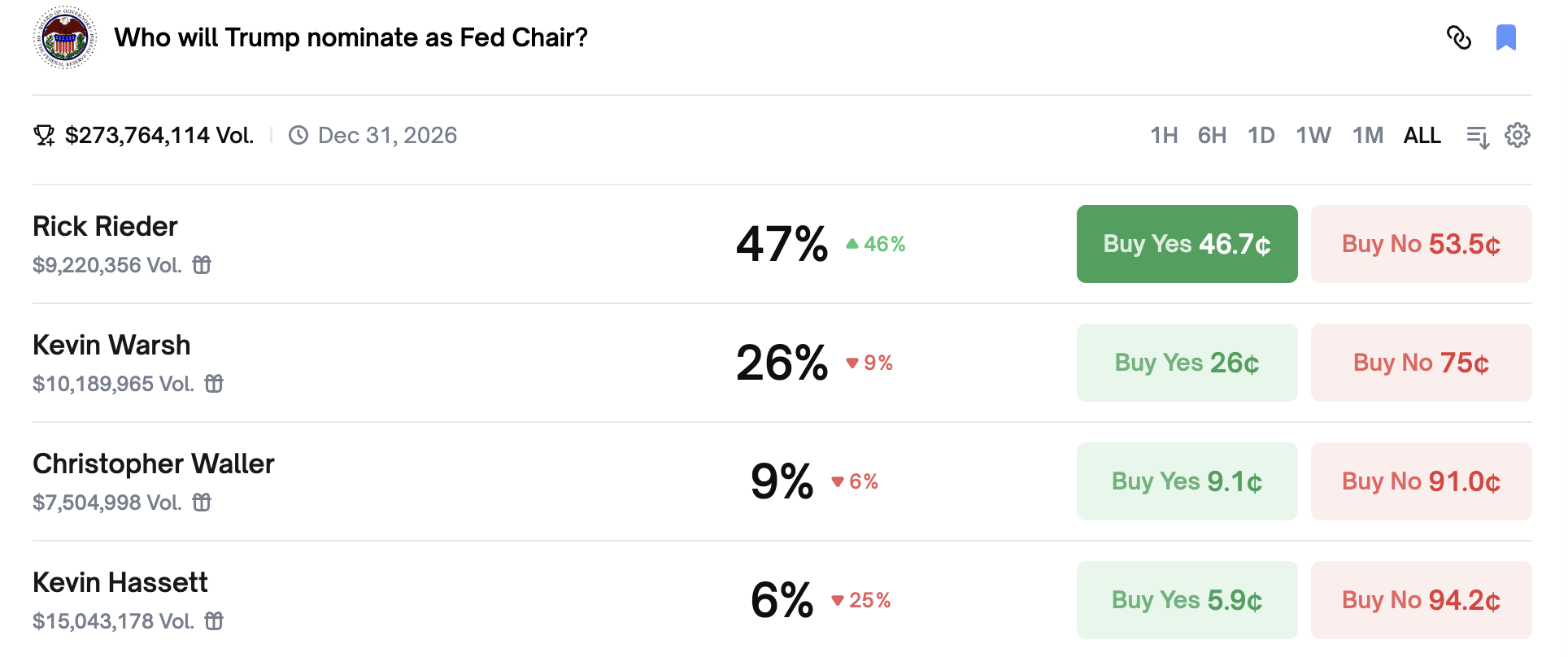
Rick Rieder is the Chief Investment Officer of Global Fixed Income at BlackRock. Although he does not have much government experience, he has consistently advocated for low interest rates based on his understanding of the market rather than politics. This background may attract Trump, who is concerned that the new Fed Chair might not "listen" once in office. Economists at Evercore ISI, including Krishna Guha, even believe that "if Rick Rieder becomes the new Fed Chair, he may advocate for three rate cuts this year." (Odaily Note: For more information on Rick Rieder, you can read the article What is Rick Rieder's stance on cryptocurrencies as the last candidate for Fed Chair? )
Hassett was once considered the most likely candidate to become the new Fed Chair, with probabilities exceeding 80%. However, Hassett is an economic advisor to Trump, and there have been concerns that Trump's nomination of Hassett would undermine the Fed's independence. Additionally, Trump has publicly stated that he does not want to lose Hassett in his administration, which has led to a decrease in Hassett's nomination probability. However, some still believe that Hassett's nomination probability is higher than 6%.
Trump has repeatedly stated that he would announce his nominee in January. At the end of December 2025, Trump told reporters in Florida that he would announce the next Fed Chair candidate at some point in January; on January 14, 2026, Trump told Reuters that he would announce the candidate in the coming weeks; and two weeks later, on January 27, Trump stated in Iowa that he would soon announce the new Fed Chair candidate, but has yet to do so.
Although Trump has been vague in his responses, it is certain that the probability of announcing a nomination in January is very high, and it is even likely that the best time to announce the nomination will be during this week's FOMC meeting.
As mentioned earlier, Powell's speech tonight will be a focal point for investors, and if Powell does not make dovish statements, the financial markets may suffer, which is clearly a scenario Trump does not want to see. Therefore, if Trump wishes to shift market attention away from the uncertain Powell, he may announce his next Fed Chair nominee during tonight's FOMC meeting, signaling a "dovish chair" to the market and reducing attention on Powell's speech or mitigating potential negative market impacts.
Tonight, let us wait and see!
Click to learn about job openings at ChainCatcher
Recommended reading:
After the premium reset, is it time for MSTR to enter?
Delphi Digital: What is the future direction of cryptocurrencies?
Pantera Capital Partner: The current state and future of internet capital markets
With a valuation of $2 billion in three years, how does RedotPay operate?
a16z in-depth article: How to correctly understand the threat of quantum computing to blockchain
Latest News
ChainCatcher
Jan 30, 2026 15:46:39
ChainCatcher
Jan 30, 2026 15:45:14
ChainCatcher
Jan 30, 2026 15:43:05
ChainCatcher
Jan 30, 2026 15:42:02
ChainCatcher
Jan 30, 2026 15:39:54