








Macro Research Report on the Cryptocurrency Market: The Crossroads of Oil Hurricanes, AI Tsunamis, and Bitcoin
Mar 13, 2026 09:23:32


I. Macroeconomic Abyss: The Shadow of Stagflation and the "Only Safe Haven" Siphon
The global financial market stands at a dangerous crossroads, as a perfect storm driven by geopolitical tensions unfolds. The recent "Black Monday" was not an isolated pullback, but a profound reassessment of asset pricing logic. As the smoke from the Strait of Hormuz obscures the lifeblood of global energy, market participants are horrified to discover that the forgotten specter of "stagflation," cloaked in the garb of geopolitical conflict, is quietly returning.
The sharp decline in the Asia-Pacific stock markets is merely the prelude to this crisis. The significant drop in the MSCI Asia-Pacific Index, along with the cliff-like declines in major indices in South Korea, Japan, and Taiwan, clearly depicts the extreme pessimism of capital regarding economic prospects. This pessimism does not stem from short-term concerns about corporate profits, but rather from an anticipatory pricing of a prolonged global economic recession triggered by supply-side shocks. Energy is the blood of industry; when the flow of blood faces the risk of interruption, the limbs of any economy will inevitably become numb or even necrotic. The synchronized drop in U.S. stock futures, along with hedge funds accumulating short positions in ETFs at a rare speed, confirms the global and institutional characteristics of this panic. Goldman Sachs strategist Ed Yardeni raised the probability of a U.S. stock market crash this year to 35% and notably listed the probability of a "stagflation" scenario separately, which itself serves as a warning. The emergence of "stagflation" as an option, alongside the "roaring twenties" (high growth, low inflation) and "collapse," indicates that the market is beginning to seriously consider a more destructive future: a coexistence of stagnant economic growth and inflation, which would completely undermine the theoretical foundation of the traditional 60/40 stock-bond investment portfolio.
In this extreme risk-averse sentiment, the flow of capital exhibits astonishing consistency: a sell-off of all risk assets and a cost-agnostic rush into the U.S. dollar. The dollar index approaching the 100 mark is not due to the strength of the U.S. economy itself, but because, at a time when the global credit system is shaking, the dollar, as the world's primary reserve, payment, and pricing currency, possesses a depth of liquidity and a scale of the U.S. Treasury market that makes it the only "deep sea" capable of accommodating massive safe-haven funds. Leading global asset management firms like PIMCO have begun hoarding cash and favoring medium-term U.S. Treasuries, with Bloomberg strategists stating that "the dollar has become the only safe haven," marking a complete shift in market logic from "risk appetite" or "risk neutrality" to "risk aversion" or even "risk escape." The rise and fall of precious metals is particularly noteworthy. Spot gold once broke through the historic threshold of $5,100 but quickly fell back to around $5,000, revealing a harsh reality: on the brink of a liquidity crisis, even ultimate safe-haven assets like gold may face pressure to realize profits to cover losses in other positions. The strength of the dollar is creating a powerful siphon effect on all non-dollar assets, including gold and Bitcoin. This macro tsunami triggered by geopolitical events has ruthlessly torn apart the psychological defenses of all risk assets and dragged digital assets like Bitcoin into the same vortex.
II. Oil Storm: Supply Cliff and the Madness of "On-Chain" Speculation
If macro sentiment is the "air" of the market, then the fluctuations in oil prices are the "bones" that move the entire body. The blockade of the Strait of Hormuz is not a mere supply interruption; it is a nuclear-level strike against the global energy order. The daily loss of 20 million barrels of oil supply is enough to send chills down the spine of anyone who experienced the oil crises of the 1970s. This figure represents nearly 20% of global daily demand, and the scale of this supply disruption is comparable to any historical crisis, if not worse. The forced production cuts or even shutdowns by major oil-producing countries like Iraq, Kuwait, and the UAE mean that the core capacity of OPEC+ has been instantly rendered useless, and the elasticity of the global oil supply curve has nearly reached zero.
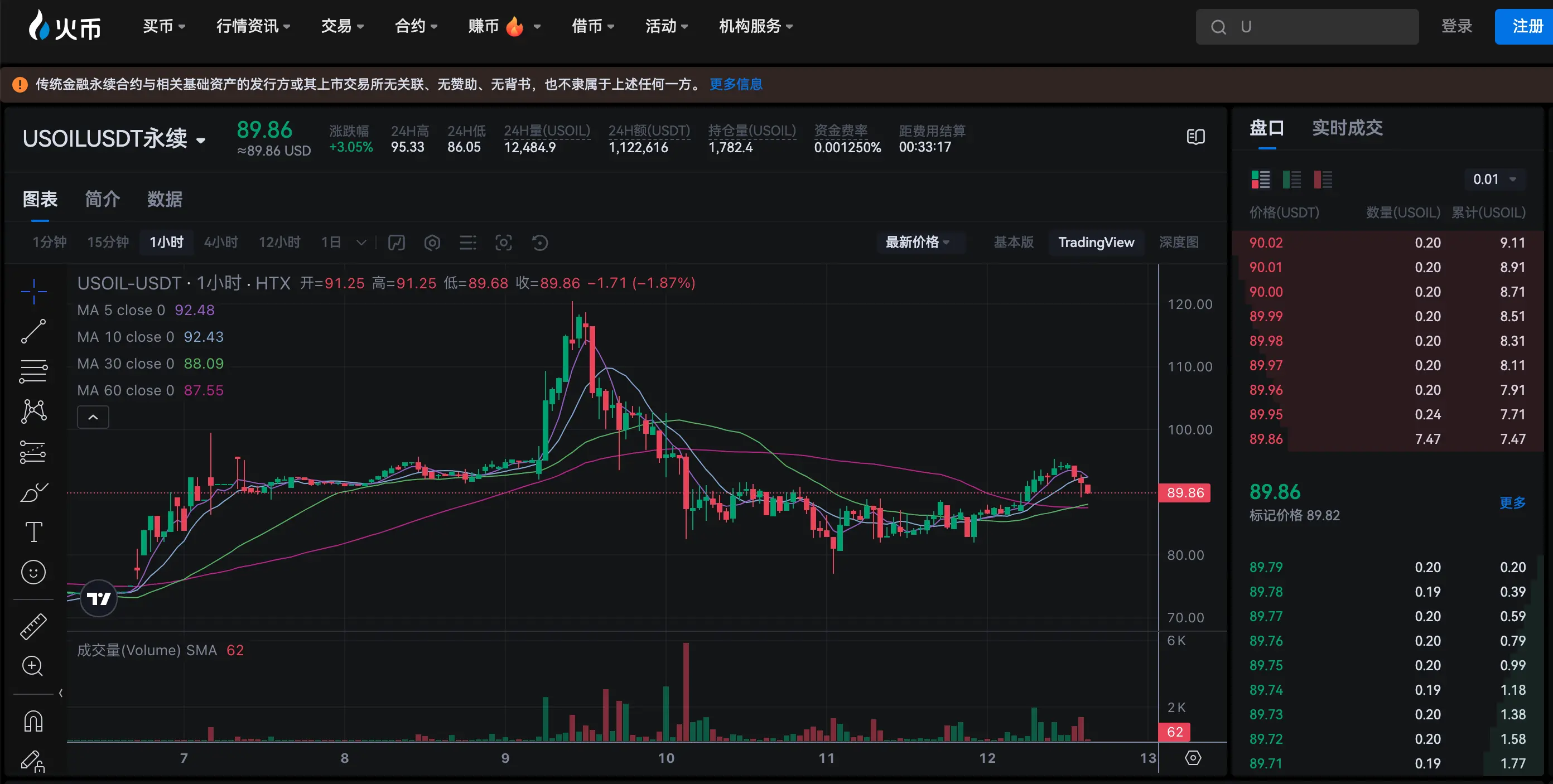
The market's initial reaction was extreme and violent. Oil prices surged by 30%, approaching $120 per barrel. This instantaneous vertical rise reflects not expectations for the future, but an acute panic over the current "lack of oil available." Goldman Sachs warned that oil prices could break through the previous high of $140 per barrel, with former traders stating that "there is effectively no upper limit." In extreme market conditions, these statements are less predictions and more objective descriptions of the potential for a non-linear market collapse. A more than 60% increase over seven trading days has pushed oil prices beyond the realm of fundamental analysis into a purely geopolitical premium pricing model.
The G7 and the International Energy Agency (IEA) urgently discussed releasing strategic reserves, an inevitable move for market intervention. Although a release of 300-400 million barrels may seem substantial, it is merely a drop in the bucket compared to the 20 million barrels per day supply gap. Its primary effect is psychological, sending a signal to the market that "we are not sitting idly by." This successfully halved the increase in oil prices, but merely pulled them back from "out-of-control madness" to a "controllable madness" range. Former President Trump's remarks about "small costs" further highlight the cold reality that geopolitical objectives currently take precedence over economic stability, indicating that the resolution of this energy crisis cannot be achieved through short-term oil releases.
This oil storm, ignited by geopolitical tensions, has unexpectedly and violently impacted the crypto world. It is no longer a distant variable affecting risk appetite under macro narratives but has directly become the focus of speculation within the crypto market. The rise of on-chain oil trading is the most Web3-characteristic phenomenon in this crisis. The trading volume and price of tokenized oil contracts (CL-USDC) on HyperLiquid have surged, with nearly $40 million in short positions being liquidated as prices rose. Rune, co-founder of Sky, even splurged $4 million in USDC to go long with 20x leverage. This scene is a perfect replication of the "spot short squeeze" in traditional financial markets within the decentralized derivatives market.
This phenomenon reveals several profound trends: First, the crypto market is no longer a closed casino; its derivatives market has begun to have the capacity to absorb and amplify the volatility of traditional assets. Second, in extreme market conditions, the 24/7 uninterrupted trading, permissionless access, and high leverage characteristics of DeFi derivatives platforms demonstrate greater flexibility and appeal than traditional exchanges. Finally, this also raises significant risk concerns. When the real-world oil supply crisis combines with the on-chain virtual, high-leverage speculative frenzy, a sharp reversal in oil prices or issues with oracle data could trigger a chain liquidation, leading to "liquidity exhaustion" in the DeFi world, with destructive potential far exceeding that of traditional financial markets. The fact that 76% of users on Polymarket are betting that oil prices will reach $120 by the end of the month reflects both market expectations for oil prices and the portrayal of crypto-native users participating in macro games through prediction markets. Oil, the blood of modern industry, is being injected into the capillaries of the crypto market in the form of "tokens," becoming another key variable determining its short-term volatility.
III. AI Tsunami: The Cold and Hot Under a Trillion-Dollar Trend
As traditional finance trembles due to the energy crisis, another wave driven by technological innovation—artificial intelligence—is reshaping the narrative of capital markets and the strategic landscape of nations at an unprecedented speed. The National Development and Reform Commission's goal of surpassing a 10 trillion yuan AI industry scale by the end of the 14th Five-Year Plan, along with over 7 trillion yuan in investments directed towards "AI+" infrastructure, injects the strongest policy momentum into this field. This is no longer mere conceptual hype but a substantial industrial investment. Data disclosed by the Ministry of Industry and Information Technology—core industry scale exceeding 1.2 trillion yuan, over 6,200 enterprises, and over 600 million users of generative AI—collectively outline a vast and rapidly growing real industry.
In this wave, the popularity of the open-source intelligent agent project OpenClaw (Crawfish) is a typical case of technological breakthroughs igniting market sentiment. Its GitHub stars have surpassed Linux, its founder has been recruited by OpenAI, and Nvidia's Jensen Huang has praised it, creating a halo effect that can ignite the imagination of any tech investor. The significance of OpenClaw lies in its substantial reduction of the development and deployment threshold for AI agents. As Huang stated, it will trigger a thousand-fold increase in token consumption, ushering in an era of "computing power vacuum" that is almost greedy for computational resources. This directly shifts the market focus from large model training to the more commercially viable AI agent track.

The rapid follow-up by giants like Tencent, along with the swift introduction of local government "Crawfish Ten Measures" in districts like Longgang and Futian in Shenzhen, perfectly showcases the Chinese-style innovation acceleration path of "top-level design - technological breakthroughs - commercial applications - policy support." The one-click deployment on WeChat/QQ allows hundreds of millions of users to access AI agents at zero distance; the introduction of government crawfish opens up the imaginative space for AI applications in public services. This top-down, point-to-surface explosive power is the fundamental driving force behind the surge of related concept stocks. The soaring stock prices of companies like MiniMax, YokeDe, and Shunwang Technology reflect the market's optimistic expectations for the landing prospects of "AI+" across various industries. They are betting that OpenClaw will become the cornerstone of AI applications in the next decade, and any companies related to computing power, deployment, and application development will share in the cake of this feast.
However, amidst the frenzy, the high-risk warning issued by the Ministry of Industry and Information Technology serves as a cold splash of water, reminding the market's calm thinkers. The network security and information leakage risks arising from OpenClaw's default configuration reveal the dark side of rapid technological proliferation. As millions of developers, enterprises, and government departments quickly deploy AI agents, the boundaries of cybersecurity will become infinitely blurred. A compromised "government crawfish" could pose far greater harm than a hacked server. The "double-edged sword" effect of AI is now evident: it is both a super engine driving industrial upgrades and could potentially become a Pandora's box for future cyberattacks and information leaks. For the capital market, this means that in the AI track, attention must not only be paid to "offensive" targets like computing power and applications, but also to "defensive" tracks such as cybersecurity and data privacy, which also hold significant investment opportunities. Investors need to make a sober trade-off between the "cold" risk awareness and the "hot" market sentiment.
IV. Bitcoin Dilemma: Crushed by the Macro Hand or Reborn from the Ashes?
As the macro market's "abyss" gazes into all risk assets, as the oil "hurricane" stirs up a speculative frenzy on-chain, and as the AI "tsunami" surges forward with trillions in capital, Bitcoin, once known as "digital gold" and a "safe haven asset," finds itself in an unprecedented awkwardness and dilemma. The price has fallen below the critical psychological threshold of $70,000, struggling to breathe above $65,000. This is not merely a price adjustment but a severe questioning of its core narrative.
Research data from NYDIG cuts to the chase: 75% of Bitcoin's recent volatility is driven by macro factors outside traditional stock indices. This means it is no longer purely digital gold or simply a tech stock, but has become a complex asset precisely "targeted" by macro variables such as geopolitical tensions, inflation expectations, and dollar liquidity. Its synchronous rise with the U.S. software sector does not reflect its "digital gold" attributes but rather the indiscriminate watering of all growth assets during times of capital flooding. When macro storms arrive, safe-haven funds first choose the dollar, and speculative funds flee risk assets, leaving Bitcoin in an extremely awkward position: it can neither provide the absolute liquidity safety of the dollar nor possess the ultimate value storage consensus accumulated over thousands of years like gold.
The current market's panic sentiment is evident in the data. The Fear and Greed Index has dropped to 8 (extreme fear), and the options market is urgently pricing for extreme black swan events. The proportion of put options traded is abnormally high, implied volatility (IV) has surged, and the skew indicator has deteriorated sharply, all pointing to a strong expectation of a short-term plunge in the market. The logic of the bears is clear and brutal: geopolitical conflicts drive up oil prices, exacerbating stagflation risks, leading to a comprehensive deleveraging of risk assets, with Bitcoin being the first to suffer. The breach of the $70,000 threshold and the fact that 75% of users on Polymarket are betting that BTC will drop to $55,000 indicate that market sentiment has completely turned bearish.
However, the other side of the coin is the unwavering bullish faith. The logic of the bulls is equally compelling. They believe that the current plunge is merely a severe washout in a macro bull market, a historical fractal repeating the rebound after the deep drop in 2022. Key support levels (such as the $64k-$65k area) still show strong buying interest, indicating that large funds are accumulating on dips. PlanB's S2F model still shows that the current price is far below the cyclical average price ($500,000), and this ultimate faith based on code and mathematics supports a group of the most steadfast long-term holders. They view the current macro panic as noise and see each plunge as an excellent opportunity to accumulate more "digital sovereignty." The gap left in the CME futures market at $68.1k-$68.2k also acts like a magnet, attracting demand for technical rebounds.
Thus, Bitcoin stands at a crossroads that will determine its fate. It could be completely crushed by the macro "invisible hand," becoming a highly volatile risk asset closely correlated with tech stocks after the narrative of "digital gold" collapses, with its price being more deeply influenced by the Federal Reserve's interest rate policies, the dollar index's movements, and the intensity of global geopolitical conflicts. Alternatively, it could be reborn from this pressure test. If it can prove that its decentralized, borderless transfer value will be rediscovered when the global payment system is threatened by sanctions and geopolitical fragmentation; if it can demonstrate that its fixed scarcity of 21 million coins will prevail over all short-term fluctuations when the fiat currency system resumes large-scale printing in response to stagflation; then today's dilemma will become its final trial before truly becoming the "ultimate safe haven asset."
The continuous net inflow into ETFs is the most striking variable in this major test. The net inflow of $568 million on March 9 stands in stark contrast to the price drop. This indicates that traditional capital has not fled but is accelerating its entry through compliant channels. They may not care about short-term macro noise but are executing asset allocation strategies that span several years or even decades. Their goal is to allocate a small portion of assets to "alternative assets" with low correlation to traditional markets to hedge against systemic risks in the fiat currency system. Therefore, Bitcoin's future depends on this prolonged game: on one side are macro traders using options and futures for high-frequency, high-leverage short-term strikes; on the other side are ETF investors making long-term allocations through spot trading, gradually wearing down the resistance. In the short term, the winter of macro sentiment and the fire of the oil crisis will continue to test Bitcoin's narrative; but in the long run, the real game has just begun.
Latest News
Cointelegraph
Mar 14, 2026 00:47:12
PRNewswire
Mar 14, 2026 00:30:00
ChainCatcher
Mar 14, 2026 00:12:46
ChainCatcher
Mar 14, 2026 00:09:43
ChainCatcher
Mar 14, 2026 00:02:58