








Jensen Huang's "ignition" failure: GTC proposed optical communication, why did the sector instead cool down?
Mar 18, 2026 18:05:05


Written by: DaiDai, MaiTong MSX
Many people thought that Jensen Huang would ignite optical communication at GTC this time.
After all, this line has been heating up for too long. From CPO to silicon photonics, from optical modules to high-speed interconnects, the market has almost pressed all its imaginations about AI infrastructure upgrades onto this. Coincidentally, OFC 2026 is also held in the same week, with the technical conference from March 15 to 19 and the exhibition from March 17 to 19. One is NVIDIA discussing the roadmap, while the entire optical communication industry chain is showcasing its strength, naturally pushing the heat to a high point.
So before Jensen Huang took the stage, the market was not waiting for an ordinary speech, but for a spark. What everyone wanted to hear was not "the future direction is fine," but a clearer statement: In the next phase, optics is the main line.
Unfortunately, Jensen Huang did not deliver this version of the message.
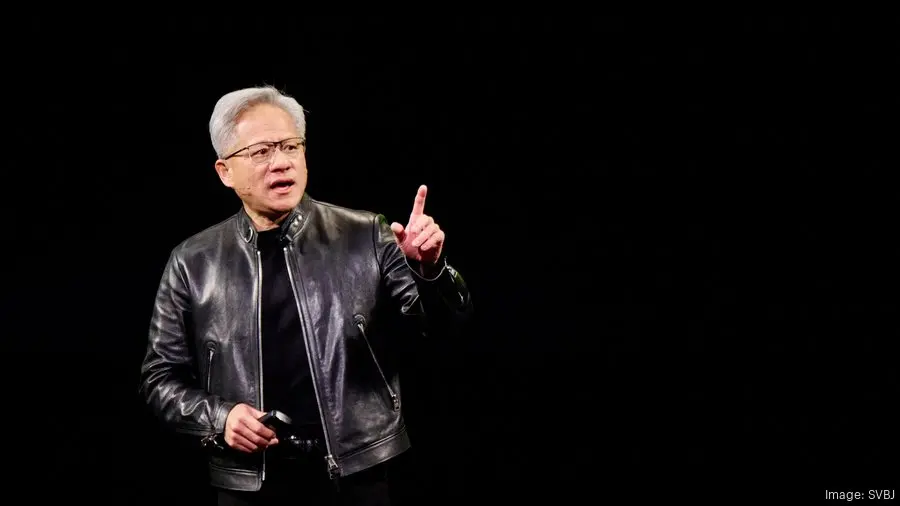
GTC Jensen Huang speech scene Source: The Business Journals
Why did Jensen Huang talk about optics, but the market still didn't buy it?
The reason why optical communication has been so hot lately is not just because it sounds advanced, but because the logic is too straightforward------As AI clusters grow larger, the pressure for data transmission increases, copper will inevitably encounter bottlenecks, so isn't it time for optics?
This story is too easy to establish. And because it is so easy to establish, the market naturally thinks one step further; since the direction is so clear, the realization shouldn't be too far away.
So before GTC, much of the capital was not discussing "whether optics will work," but rather betting in advance on whether Jensen Huang would present this matter more aggressively than everyone expected.
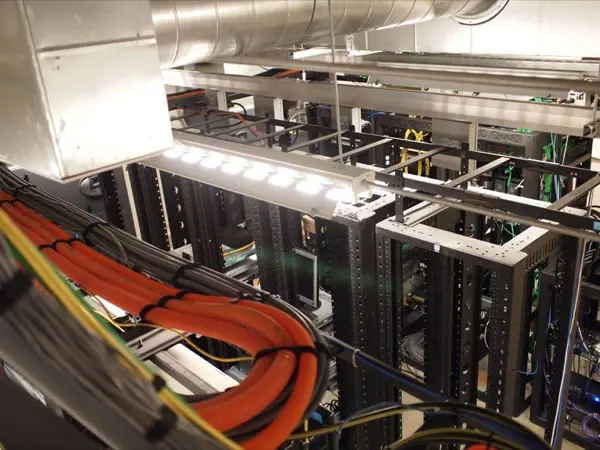
Data center machine room and wiring Source: The Fiber Optic Association
The issue is not whether he mentioned optics.
He certainly did, and he mentioned it heavily. However, what Jensen Huang actually conveyed was that optics is indeed important, but copper will not exit the stage in the short term, "NVIDIA plans to continue using copper-based connections and updated optical technologies in upcoming platforms (including Vera Rubin Ultra and future systems)."
The market originally wanted to hear that optics would soon take the lead; just this slight difference was enough to make the market change its face.
This is also the most awkward part of the market, because what stocks fear most is often not bad news, but rather that the good news is not as good as imagined.
The issue is not "whether optics is good," but "whether it will be realized now."
One of the most easily misunderstood points this time is that many people will interpret it as "optics is not working" or "copper has won."
In fact, neither is true.
A more accurate statement is that the long-term logic of optics has not changed; what has changed is the market's imagination of its realization speed. NVIDIA's official technical blog description of the Vera Rubin platform has actually made this logic very clear: larger-scale systems will use direct optical connections for rack-to-rack connections, but many positions within the rack are still based on copper spines and pre-integrated copper cables.
In simple terms, in many places within the rack, copper is still the main force; it is only in larger-scale, cross-rack areas that the importance of optics begins to rise significantly.
Therefore, what GTC truly corrected was not the direction but the timetable. Previously, the market bought into this line, buying a very large future; now the market is starting to question: Who will realize this future first, and when will it be realized?
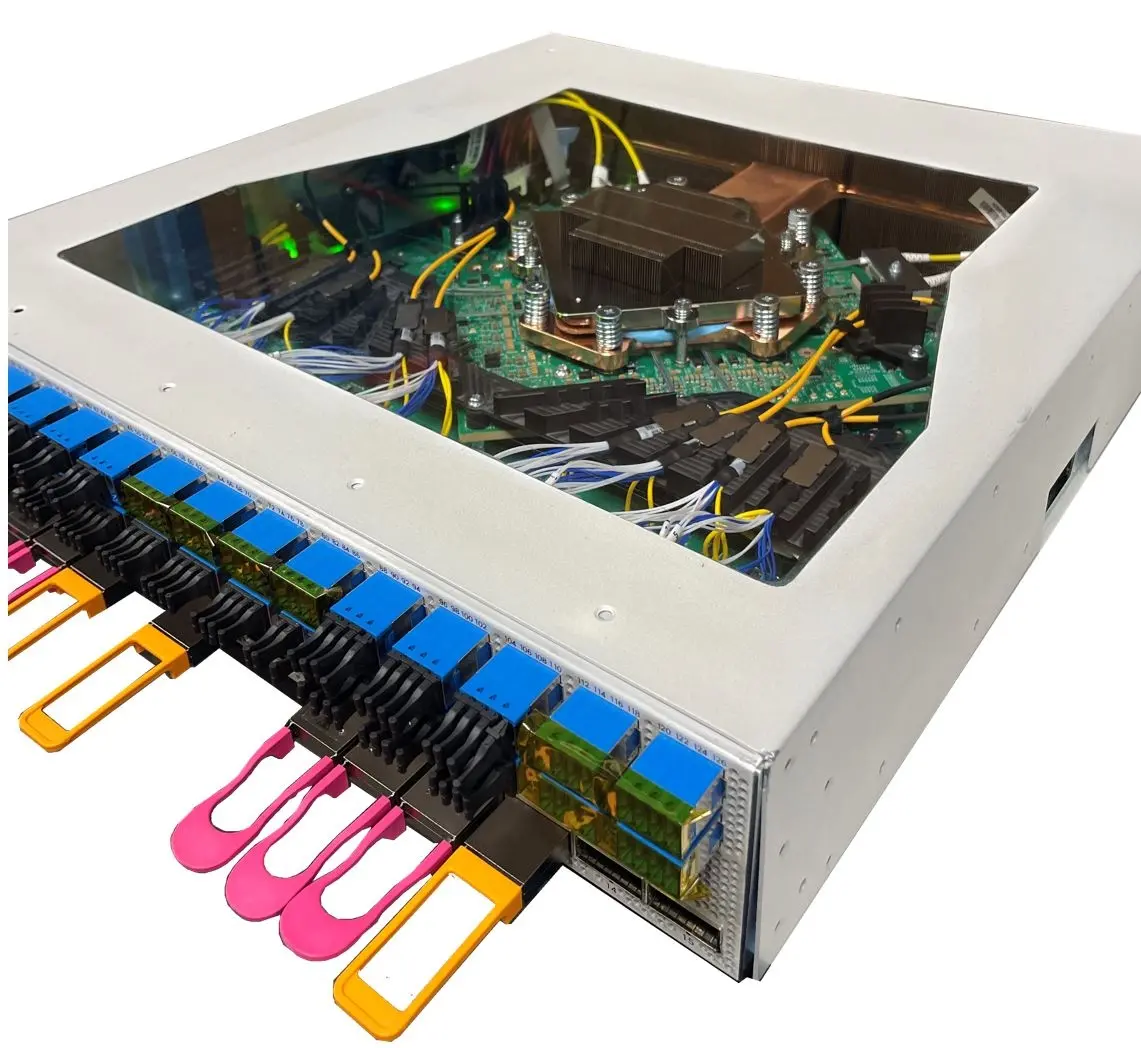
CPO equipment/system display Source: Cisco Blogs
The market has shifted from "fully transitioning to optics" to "beginning to differentiate."
Because of this, after the speech, it was not a "full line surge," but rather a bit of chaos followed by differentiation.
Barron's summary of the market this time is quite accurate: the market interpreted Jensen Huang's statement as "both copper and optics will continue to be used," which directly shifted the sector from a "as long as it involves optics, it will rise" thematic trade back to a "who truly benefits, who is just being lifted by the heat" differentiated trade.
If we zoom in on individual stocks, this differentiation becomes even more apparent.
- Lumentum (LITE.M) can still be repeatedly discussed by the market not just because it belongs to the "optics" line, but because in investors' minds, it is no longer just a concept stock, but has been placed on the list of "future opportunities to truly enter the next-generation interconnect system." Because of this, even though short-term sentiment may fluctuate, the market's understanding of it is more likely to remain at "rhythm changes" rather than "logic disappearing." Barron's mentioned that on March 17, Lumentum was one of the few stocks that managed to close up;
- Coherent (COHR.M) has a position somewhat similar to Lumentum, but the market's pricing for it will not be exactly the same. Once the sector shifts from "telling a big story" back to "grounding the story," investors will pay more attention to which layer each company truly benefits from, how long realization will take, and whether expectations have already been overly inflated. It does not lack direction, but it is more likely to enter a phase of "there is logic, but the timing needs to be recalculated." Barron's noted in the same day's review that Coherent's performance was significantly weaker than Lumentum's that day;
- Ciena (CIEN.M) is relatively special. It is not easily pushed up and down by emotions like some highly elastic names. In this wave of discussion, it is more like a stock that prompts the market to think about "how the future optical network will truly unfold." Its significance is not just riding a buzzword, but reminding everyone: if large-scale AI infrastructure is to continue upgrading, the final competition will not just be about a device story, but how the entire network capability moves forward. Barron's post-GTC summary also placed Ciena in a category of "relatively stable within the optical chain";
- Applied Optoelectronics (AAOI.M) is more like the most typical representative of high elasticity in this wave of market activity. Such stocks are often the easiest to be quickly pushed up by the market when sentiment is good; conversely, as long as the catalyst is not strong enough to continue pushing up expectations, it is also the easiest to bear the pressure of profit-taking. Its volatility precisely illustrates one thing: when the market begins to doubt "whether realization will be slower than imagined," the first to be hit is often those names that have risen the fastest and have the fullest expectations. Barron's report on March 17 also placed AAOI on the pressured side;
- Credo (CRDO.M) exposed another very important change after this GTC: it is not enough to just be associated with "copper" to automatically benefit. Jensen Huang clarified one thing this time------copper will not exit immediately, but that does not mean all copper chain companies will be immediately rewarded by the market. Because funds will next question more specifically: which segment of copper connections benefits the most? Is it short-distance? Is it AEC? Or other links? Barron's review shows that Credo also experienced significant volatility in this round of sentiment, which itself indicates that the market is no longer accepting the simple narrative of "as long as you are on the right theme, you will rise together";
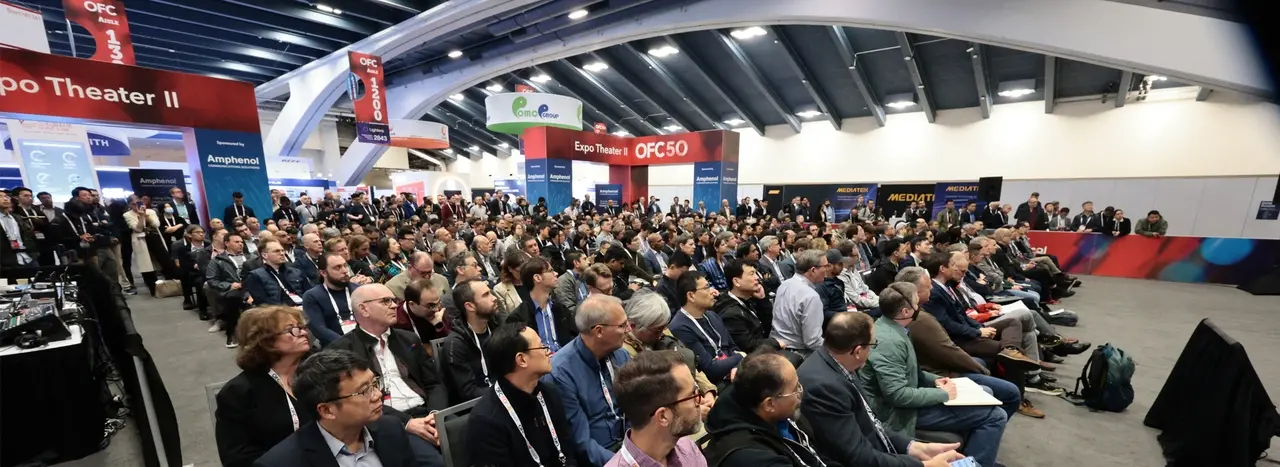
OFC venue live shot Source: Public news images
Ultimately, when looking at these stocks together, the most noteworthy aspect is not who rises or falls, but that the market has begun to view them as assets with different positions, different realization rhythms, and different certainties.
In the previous phase, everyone was more willing to put them in the same basket, but starting from GTC, this basket is being dismantled. AI interconnect is not a "choose between optics and copper" question, but a division of labor question of "who uses it first and where."
In essence, Huang did not deny optics; he simply did not deliver the version the market most wanted to hear. Therefore, after GTC, the market is no longer just looking at "whether there is a story," but rather "who is closer to grounding, who is closer to realization," which is why, even though they are all in the optical communication line, stock price performances have begun to show clear differentiation.
In the previous phase, many companies could still be traded together in the same basket; but from now on, the market will look increasingly closely: who benefits first, who validates first, and who was just pushed up by sentiment.
The real differentiation has just begun
The direction of optics has not changed; what has changed is the market's view of this line.
Previously, everyone was more willing to pay for imagination first; moving forward, the market will place greater importance on realization. Therefore, the real gap that will open up later is not who tells the story better, but who turns the story into performance sooner.
Let's wait and see.
Latest News
ChainCatcher
3月 20, 2026 03:07:42
ChainCatcher
3月 20, 2026 03:06:45
ChainCatcher
3月 20, 2026 03:02:20
ChainCatcher
3月 20, 2026 02:58:39
ChainCatcher
3月 20, 2026 01:56:40