








WeChat Integration OpenClaw: Step-by-Step Installation Guide, Pitfalls to Avoid, and Integration Suggestions
Mar 25, 2026 15:16:55


Author: Shouyi I Biteye Content Team
On March 22, the official WeChat public account announced the gray testing of AI Agent for personal WeChat. Connecting the local OpenClaw to WeChat, turning the social app used daily into a "universal remote control" for the computer, is undoubtedly the happiest news for the lobster army these days.
The logic behind WeChat's "pattern opening" is very simple: it not only wants to create a large model but also aims to firmly hold the entrance of AI interaction. Regardless of whether you are using OpenAI or a local model, as long as you use the ClawBot plugin, the traffic and ecosystem remain within WeChat.
In three minutes, let’s discuss some practical details: how to install? What are the benefits? What are the pitfalls? And what "hidden rules" are concealed in the official agreement.
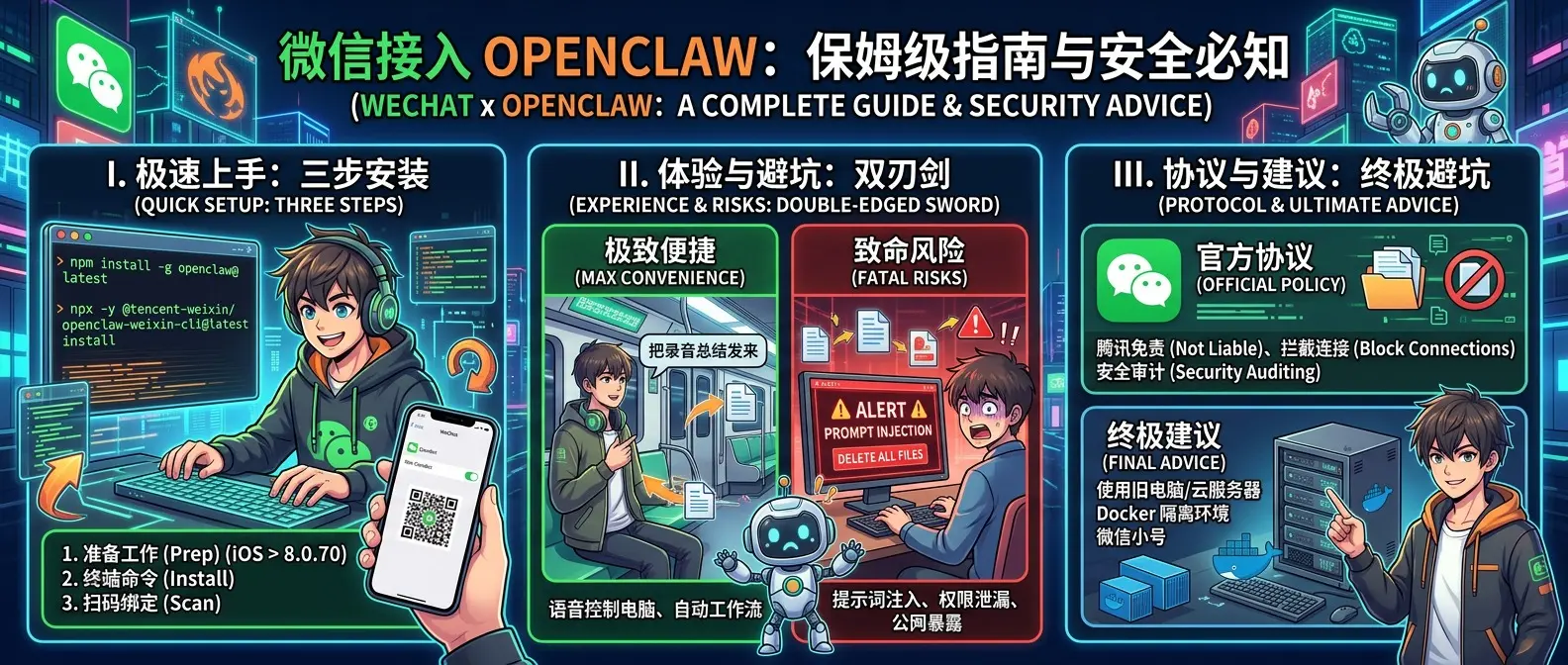
1. Quick Start: Threshold and Foolproof Installation
WeChat ClawBot is a plugin feature officially launched by Tencent, allowing users to bind their locally running OpenClaw instance with their WeChat account, enabling the sending and receiving of messages through WeChat to drive the local AI Agent.
Core Mechanism:
The local OpenClaw establishes a long connection with WeChat through a CLI tool.
WeChat serves only as a message transmission channel, does not store conversation content, and is not responsible for AI output.
Currently supports one-on-one chats only, does not support group chats, and does not support AI actively pushing messages.
- Preparation
Hardware: A computer that is always on and connected to the internet, or a cloud server to run OpenClaw.
Software: iOS WeChat, must be updated to the latest version 8.0.70 (Android users currently have limited access).
Tip: After updating, check "Settings - Plugins" to see if ClawBot is available; if not, restart WeChat a few times.
- Three-Step Installation Method
Step 1: Open the computer terminal and run a line of code to install OpenClaw: npm install -g openclaw@latest
Step 2: Run the WeChat-specific plugin command: npx -y @tencent-weixin/openclaw-weixin-cli@latest install
Step 3: The terminal will pop up a QR code. Take out your updated WeChat on your phone, go to "Settings - Plugins - ClawBot," scan the code, and you're done!
2. Core Points of Tencent Clawbot Service Terms
After installation, first understand the platform rules to avoid pitfalls and ensure account security. Tencent has clarified the following boundaries in the ClawBot usage terms:
Tencent only provides a message transmission channel, does not store conversation content, and is not responsible for AI-generated results.
The platform will conduct security audits on transmitted content; violations may be intercepted, and functionality may be restricted in severe cases.
Although conversations are not retained, IP, device information, and operation logs will be recorded for security audits.
Currently in gray testing phase, Tencent reserves the right to adjust, restrict, or terminate services at any time.
3. Real Experience: Why Can WeChat Become an AI Super Gateway?
Integrating OpenClaw into WeChat essentially turns WeChat into a Gateway for your local computer. This approach brings extreme convenience but also exposes the underlying risks of the Agent unchanged.
Extreme Convenience ➡️ Suitable for: Geeks, Efficiency Fanatics, and Team Leaders
WeChat itself has an extremely complete interaction ecosystem (voice, image transfer, file sharing), which amplifies the capabilities of OpenClaw to an epic level. For example, while squeezing into the subway after work, you can casually send a voice message to the file transfer assistant: "Summarize the meeting recording on my desktop into Markdown and send it over." The computer at home automatically gets to work, and a few minutes later, WeChat receives the file. No more dragging files back and forth while keeping the computer on.
Exposed Risks ➡️ Discouragement for: Novices, Core Confidential Employees, and Mindless "All Permissions" Advocates
OpenClaw itself has operating system-level deep permissions. Once file read/write and code execution capabilities are enabled, the risks amplify when connected to the public network (WeChat). The main risk points are as follows:
Data Review Risk: WeChat servers are located within China and are subject to the "Cybersecurity Law" and "Data Security Law." All transmitted content will pass through Tencent servers, with real-time filtering of sensitive keywords (DeFi, wallet, crypto, transfer, etc. are easily triggered).
Account Security: The main WeChat account is bound, and if OpenClaw encounters issues, it may affect WeChat Pay, social functions, etc., with a high replacement cost; additionally, sharing WeChat chat records with OpenClaw poses privacy risks—if platform security vulnerabilities arise, your sensitive conversation information may be leaked.
Prompt Injection Attacks: If the phone is used by others, malicious commands may be issued through WeChat.
Biteye's Ultimate Advice: After reading all this, are you still itching to try? The safest combination is to run OpenClaw on an old computer or cloud server that is gathering dust, deploying it in isolation through Docker; create a new WeChat account specifically for binding ClawBot to avoid risks to the main account; and strictly limit the working directory in the OpenClaw configuration, adhering to the principle of least privilege.
If configured properly, WeChat + OpenClaw may currently be one of the most convenient and seamless entry points for AI Agents.
Have fun, but please maintain a sense of caution—safety first!
Latest News
ChainCatcher
Mar 26, 2026 08:41:41
ChainCatcher
Mar 26, 2026 08:38:56
ChainCatcher
Mar 26, 2026 08:35:29
ChainCatcher
Mar 26, 2026 08:33:50
ChainCatcher
Mar 26, 2026 08:25:05